
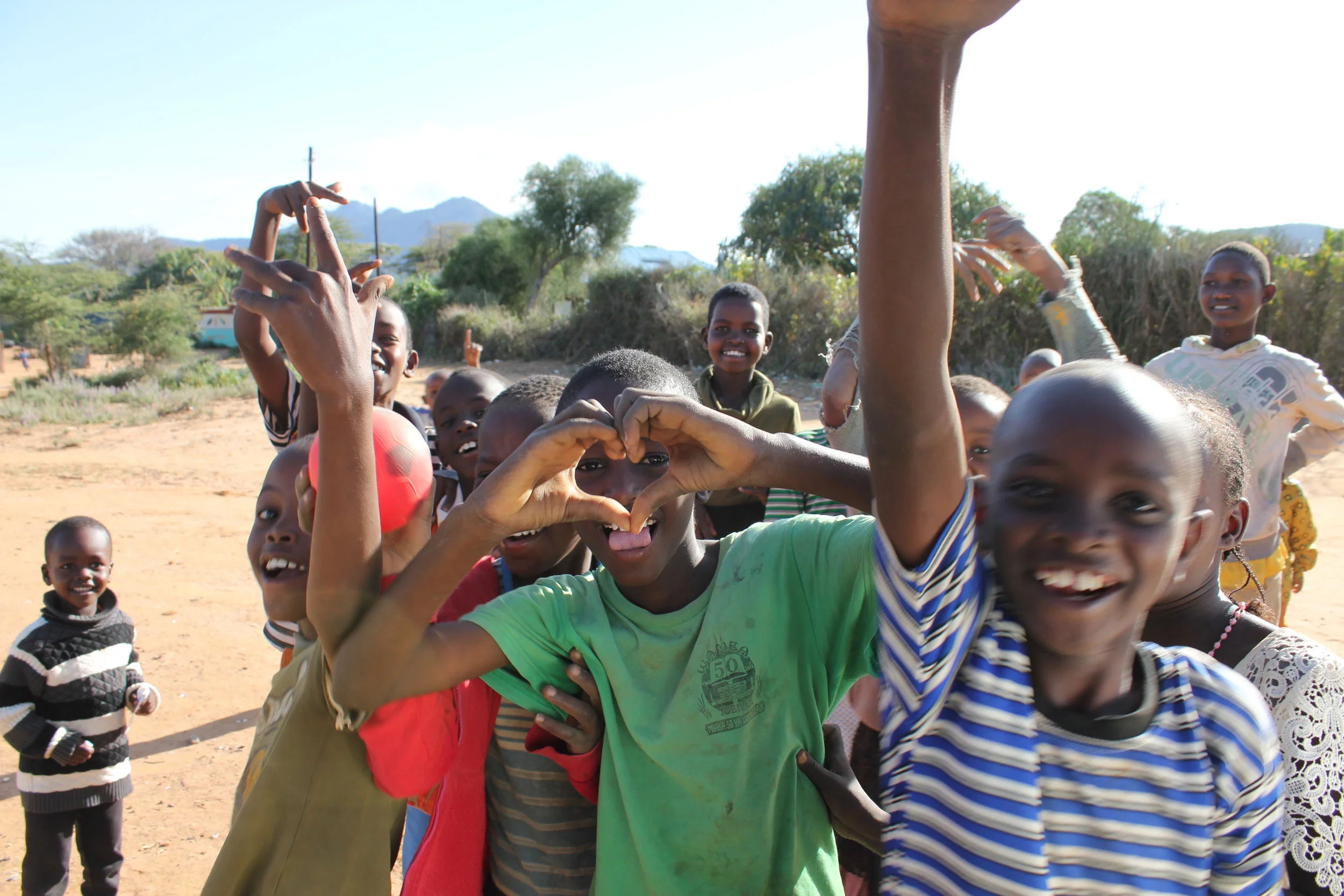
These moments were very different — a nursery school lesson under a tree, a group of women dancing through the gate of a clinic, a bead seller greeting friends along the road, more than a dozen hands raised in a circle of women who had turned reclaimed time into new livelihoods, and a group of girls seated in three rows under a tree, honest enough to tell us what they still need.
Read MoreAnother visit brought us to a nursery school serving about 40 preschool children. The teacher, Moses — a young man in his mid-twenties who studied tourism — leads the class under a tree. The space is fenced in with branches, with a makeshift roof providing some shade from the intense sun. A worn chalkboard stands at the front, and the children sit on stones scattered on the ground.
Read MoreOne of the most memorable moments of the visit was arriving at the Westgate Clinic for a WASH workshop. The clinic sits just down the road from the boundary of Samburu National Park — a reminder that in this part of Kenya, wildlife and daily life exist in close proximity. On some days, we were told, elephants wander by the clinic in search of the corn the doctor has recently planted in his kitchen garden.
Read MoreWe began with a visit to the head teacher's office — formal greetings are the proper procedure, and that courtesy sets the tone for everything that follows. From there, we were led outside to meet the girls of the Flow Club, who were seated in three rows of chairs under a tree in the front of the school yard.
Read MoreDuring the visit, I was fortunate to attend an informal Samburu informal Samburu Sisters meeting our staff had so graciously organized, where women gathered to talk openly about the challenges they face and the ways they support one another. Listening to the women speak, I was struck by how vividly they remembered life before the well — and how much had changed.
Read MoreMy recent visit to Samburu was my first time traveling to this part of northern Kenya. Nearly twenty years ago, I lived and worked in rural western Kenya, so returning to the country brought back many memories. Samburu, however, was new to me — and yet in many ways it also felt familiar. For more than two decades I have worked in global health, often focusing on how communities strengthen health and wellbeing from the ground up.
Read MoreAs I stood staring at the Golden Gate Bridge, its towers wrapped in mist, a glistening rose in my eye. No, it wasn’t a tear—for Morans, warriors, do not cry. That lesson had been instilled in me since childhood. But in that moment, memories swept over me so vividly I feared I might wake up to the bleating of goats and the rhythmic clatter of cow hooves being driven out to pasture.
Read MoreThe sound of snow beneath my boots startled me. I had expected it to crack like breaking glass, but instead it whispered—a soft crunch, almost like the sand of Samburu shifting underfoot. In that sound, I could feel myself being pulled across time and space. My eyes, fixed on the white horizon of my first winter in America, glazed back to the red plains of Samburu. The snow pulled me home.
Read MoreAs I stood staring at the Golden Gate Bridge, its towers wrapped in mist, a glistening rose in my eye. No, it wasn’t a tear—for Morans, warriors, do not cry. That lesson had been instilled in me since childhood. But in that moment, memories swept over me so vividly I feared I might wake up to the bleating of goats and the rhythmic clatter of cow hooves being driven out to pasture.
Read More