
Boaz Leleina's Story, Part II: Life as a Moran
When Distant Hands Shape a Life
〰️
When Distant Hands Shape a Life 〰️
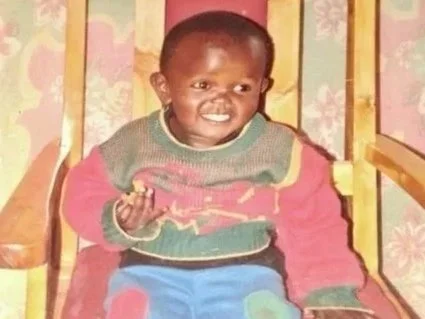
Boaz, as a young child.
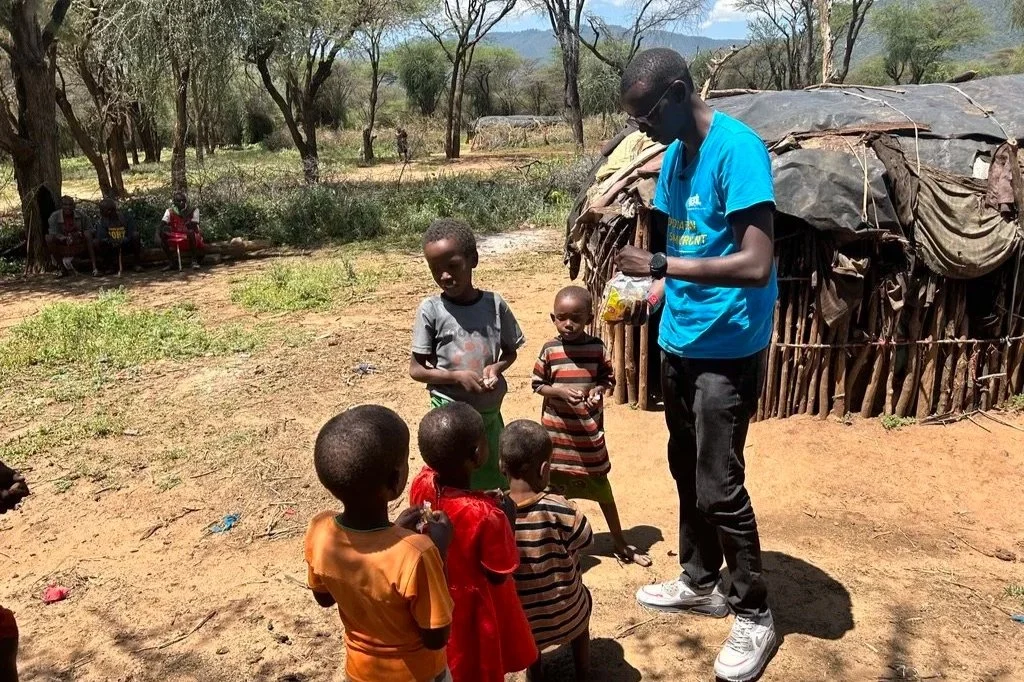
Boaz, back in Samburu in his adulthood.
The sound of snow beneath my boots startled me. I had expected it to crack like breaking glass, but instead it whispered—a soft crunch, almost like the sand of Samburu shifting underfoot. In that sound, I could feel myself being pulled across time and space. My eyes, fixed on the white horizon of my first winter in America, glazed back to the red plains of Samburu. The snow pulled me home.
The Gift of Unseen Hands
In Samburu, survival is communal. A single herder cannot defend the cattle from lions, nor can one mother alone fetch water for her children. The Swahili say: “Kidole kimoja hakivunji chawa”—one finger alone cannot crush a louse. Community is strength. Yet I would learn that my community was larger than the people around me; it stretched beyond horizons I could see.
The first time I drank from the well dug by The Samburu Project, I was just a boy. I remember walking barefoot in the heat, dust clinging to my skin. The air shimmered, cattle bellowed impatiently, and children jostled forward, cups and calabashes in hand.
“Then I bent down, cupped the cool water in my palms, and tasted something close to a miracle.”
Around me, goats pressed forward. Women laughed and sang in relief. For the first time in days, thirst loosened its grip on us. That water had come not from the clouds or the rivers we knew, but from the kindness of strangers—people from lands I had never heard of. They would never know my name, but their hands had reached across oceans to touch my life.
At the time, I did not understand what it meant. But looking back, that well was more than water. It was proof that unseen hands could alter a boy’s destiny.
The First Glow
Years later, in a dusty classroom at Ndururumo High School, I felt that same sense of miracle again. Rows of old computers sat humming, their screens glowing with a strange, bluish light. To many of us, they seemed magical—machines that belonged to another world.
I touched the keyboard cautiously, as if it might bite. The letters looked foreign, the cursor blinked like an impatient eye. Yet when words appeared on the screen, responding to my fingers, I felt the same awe I had felt at the well. Here was another gift from distant hands, another unseen community offering me possibilities.
I leaned closer, the whir of the machine filling my ears. In that moment, I knew I wanted to learn this language, this new way of shaping the world. Technology, like the well, could quench thirst—only this time, the thirst was inside me.
The Warrior’s Struggle
“I guarded my dream the way I once guarded my herd.”
But awe alone does not carry you far. The world of computers was foreign, the lessons swift, the concepts slippery. I stumbled. English terms blurred together; algorithms felt like riddles designed to mock me.
Yet I remembered the discipline of Moran life. The patience of waiting for rain. The endurance of trekking miles beneath a merciless sun. The courage of standing watch through the night, even when lions prowled near. Those same lessons became my tools. I wrestled with syntax the way I once wrestled with calves.
Slowly, painfully, the machine began to make sense. I was no longer just watching its light—I was beginning to speak its language.
Beyond the Horizon
The well, the computer—each was a reminder that my story was never mine alone. I was being carried by a community larger than I could see. A community of strangers, of teachers, of organizations, of people who believed in the possibility of a boy they had never met.
And as the Samburu proverb teaches, “Kemat Nkerai Ntapani Ee Lkulikae”—children drink from the wells dug by others.
“I drank deeply, and each drop filled me with a new kind of hunger—not just to survive, but to discover, to build, to give back.”
The Spark of a Dream
I could not have explained it then, but a dream had begun to form. If a well could rise in Samburu through the kindness of unseen hands, if a computer could arrive in a dusty classroom to open my mind, then perhaps one day I could cross those unseen horizons myself.
From that point forward, I carried a new fire. It would burn through struggles, carry me past rejection, and push me across oceans.
But that is a story for Part Three—the road to America, and the trials that tested whether a Moran’s courage could withstand more than lions.